

Joy is stalking me.
It started when Minneapolis-based Creative Director Peter Anderson asked me to be part of his Leading with Joy project. It got me thinking more critically about how I see joy and more importantly, how I leverage it as both a choice to be made and a skill to be honed.
Then I joined the board of Chicago Tap Theatre, where we emphasize the power of joy via performance, education and community service. In creating our gala video we highlighted joy as a resource, specifically on how experiencing joy allows us to be more focused and powerful.
Joy is not an end result. It’s the doorway and path out of survival mode and into a thriving mindset.
As my joy obsession grew, I began asking everyone I encountered: What’s bringing you joy lately? I was surprised that all of them (from people I’d just met to friends I’d known forever) replied “hmmmm that’s a great question.” Some hmmms were longer than others and some had a hard time coming up with an answer. Others had to pause to weigh what was really bringing them joy and what wasn’t.
That was the final straw. Yes, joy was indeed stalking me. And no, I didn’t mind one bit. It was an invitation to learn more about joy and how to co-create with it.
With all of the distractions in the world, joy can seem like an extra we just don’t have time for. It’s the dessert we wish we could have. Unfortunately, we’re on a diet of too much to do with too few resources and joy just doesn’t make the cut. We may also feel like we can’t allow joy in, not when so many others are without it. And yet, joy can be a choice to empower ourselves to act.
Joy is an act of resistance. – Toi Derricotte 1
What if we were to reframe joy as a strategy for success? Not only for ourselves, but for our colleagues and organizations?
Making Space for Joy
We may think we don’t have time for joy, but we can’t afford to not make space for it. Joy makes us more resilient. It lowers our blood pressure and cortisol, enhances our immune system, improves digestion and so much more. If you want to geek out on some of this science, below are articles for your rabbithole. 2
"Joy is a powerful tool for productivity. It is not the reward for a job well done; it is the fuel that makes the job possible." —Ingrid Fetell Lee (Author of Joyful)
Growing resilience is a focus area for all of my clients. Not just some or many… ALL of them. Resilience allows us to stretch beyond our current comfort zones. Being comfortable being uncomfortable opens up new professional and personal possibilities. We can take on new challenges and grow our influence thereby growing our impact.
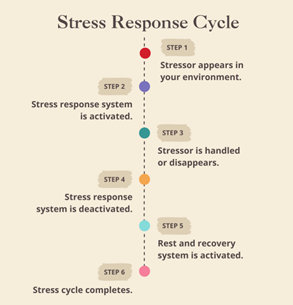
Becoming more resilient requires a basic working knowledge of our nervous system and the stress response cycle. We experience stress due to a stressor, our nervous system and body goes into response mode to manage this stress until the stressor is removed. Then we need to complete the stress response cycle so the stress leaves our system.
In a nutshell, even when the stressor is gone, the stress remains in your system. The way to handle that stress is to complete the stress cycle (step 4). For more information on the stress response cycle, Authors of Burnout, Emily and Amelia Nagoski have you covered in this six minute video.
Last month I was working with a group of Columbia Law School students. I’d spoken about methods used to complete the stress response cycle many times. During our group discussion, we noticed that many of these methods not only complete the stress response cycle, they bring joy.
Connecting with someone you care about
Physical activity
Breathing practices
Creative expression
Laughter
Affection
Crying
Being in nature
While all of the above actions complete the stress response cycle, only you can choose which will serve you most based on your situation and preferences.
I love being in nature, but may not have access to get outside when I need it most. Instead I might choose to pop on some music for a quick dance break. In cases where it doesn’t feel like you can leave the situation, breathing or touchpoint practices can be done in the moment without calling attention to them. For example, we can slow down our breath or extend the exhale longer than the inhale. We can also notice what points in our body are touching something: our feet on the floor, seat in a chair, hands on our thighs, etc. We have access to both of these practices even in the midst of a heated discussion. At that moment, joy can simply mean lowering our stress by 5 %.
Not only are situations different, people are. Everyone will have their own unique access points to joy.
Think about what brings you joy. Jot down a few of those people, places, things or experiences that bring you joy.
In addition to being in nature, my go-to joy creators include: dancing, petting my 17-year-old chihuahua, getting lost in a good drama like The Pitt, spontaneous conversations with new people, and singing at the top of my lungs to a favorite song on repeat.
When we touch joy, even momentarily, we tend to our nervous systems and our brains, not to mention we ease our heart and decrease the stress in our body which has an impact on our overall health and wellbeing.
Joy is a non-negotiable.
Joy as a Practice (for both you AND your team):
How do we bring some vitamin J into daily life? The same as with anything. We make it a practice. It’s not a to-do or a goal or anything “out there.” It is a mindset and a choice. You can choose behaviors for yourself and embed them into meetings and processes that also support your team.
As noted earlier, these behaviors are not one-size-fits-all. Try them on, experiment with them, ask your team what behaviors support joy in them. You don’t have to do all of the heavy lifting.
Some behaviors don’t immediately feel applicable to the workplace. Dance, for example. How does one effectively bring it into an office environment? Well, where there’s a will, there’s a way.
Back in my advertising days, I would pull the team into my office for “mandatory” dance parties. 3 These were stress-busting game-changers that also led to more engagement, connection and ultimately effectiveness. Especially after a particularly stressful client call, everyone appreciated a few moments to blow off steam. We freed up our brains. Now we could get creative and come up with the best solutions for our clients.

Not everyone participated. Some took one look at us, rolled their eyes and passed by the office. It still shifted the mood for them. Remember, laughter is another way to release stress.
What worked about this joy practice is that the space supported and encouraged it without any unnecessary pressure or guilt. It was an invitation. People could participate in whatever way felt comfortable and all contributions were appreciated.
Your turn. What behaviors bring you joy? How might you apply them to your team?
Want a step by step?
Name the behavior/practice.
Communicate with your team clearly about how it will be applied.
Commit to a specific amount of time (one week, 3 meetings, etc)
Ask for feedback: what’s working? What’s not? How might you adapt the practice?
Adapt and change up the behaviors to include feedback and ideas for future behaviors.
Making this a practice means you don’t have to get it right the first time or every time. You’ll just continue the practice and let it evolve.
Here are some to try with yourself and your team:
Acknowledgment
At least one person or team member per day
Don’t wait until the finish line: Small wins, progress, and benchmarks
Closing loops
Small acts of kindness
Replying to emails
Pausing to get present and reflect before reacting
Noticing people, moods, reading the room
Presence practices
Setting intentions before calls, meetings
Sharing intentions at the top of meetings
Reflecting: Post meeting, mid-day, end of day: you choose
Leading a Culture of Joy
"A joyful culture is a resilient culture. When people feel safe to find joy, they feel safe to innovate." — Amy Edmondson (Harvard Professor on Psychological Safety)
What can organizations do to create space for joy at a macro level?
On my trip to New York, I got to visit a colleague at Google. Every space we entered was designed for joy. The color, the light, the space, and the food. The space invited spontaneous conversations, deep thinking, and collaboration.
How can you apply this at your organization?
First assess your current state. What aspects of the work and the environment could use an infusion of joy?
Office space
Meetings
Processes
Teams/Departments
Cross functional
Client journey
Employee journey
What ideas do you have about ways to connect the above to your organization’s values and purpose? What do you already know could make a positive impact? What don’t you know? Ask around. Consider creating a joy task force to lead the movement. Include multiple types of roles and disciplines in the conversation.
How will you know if any changes you make work? Pick success benchmarks and measure them.
Leveraging joy as a strategy and creating practices to apply it in your life and the life of your organization will create lasting change for you, your team, and organization. Better yet, this joy just might ripple out into your communities and the world.
Consider that for a moment. What might the world look like if more of us decided to choose joy rather than chase happiness?
Footnotes
1I’d always heard this quote attributed to Audre Lorde. I even have a sticker with her face along with this quote. In researching this article I found the original attribution to Toi Derricotte, one of Lorde’s contemporaries, from her poem “The Telly Cycle.” Both Lorde and Derricotte are known for their aligned philosophies. No surprise that researching an article on joy introduced me to a new poet to explore. If poetry brings you joy, check out more of Derricotte’s work.
2https://www.health.harvard.edu/staying-healthy/understanding-the-stress-response
3 My current 60 minute Dance Party Playlist: https://open.spotify.com/playlist/6RNmeqNw7HXCl0jVHolBWw?si=734267bda97c45aa

About the Author
Lead True Certified Coach Melissa Thornley operates at the intersection of left brain and right brain. She has years of experience leading creative teams in Chicago, New York, and London specializing in emotional intelligence and instinctive working styles.
She works with coaching clients - from emerging leaders to those leading high impact teams - on a variety of topics including self compassion, leading from empathy, and the power of positive neuroplasticity. Regardless of the format of Melissa’s coaching, she maintains a foundation of collaboration and customization for each client.
Read more from Melissa Thornley below.



Explore the powerful impacts that leveraging joy can have on you and the teams that you lead.